How to Tell if Palm Coast Landscaping Advice Is Actually Useful
May 4, 2026Palm Coast Landscape Design for Front Yards
May 4, 2026For Palm Coast flower beds, mulch should be laid about 2 to 3 inches deep over weeded, moist soil, kept a few inches back from plant stems and tree trunks, and refreshed roughly once or twice a year as it breaks down. Organic mulches like pine bark, pine straw or eucalyptus work well here because they hold moisture in our sandy soil, block weeds, and keep roots cooler in summer heat. Getting the depth and placement right matters more than the brand you buy.
We install a lot of mulch around Flagler County, and the same mistakes show up again and again: too thin, too thick, or piled against trunks. Here is how to do it right, step by step.
What mulch actually does in sandy Florida soil
Our soil is mostly sand. Water drains through it quickly and it holds very little organic matter, so plant roots dry out fast in the heat. A good layer of mulch helps in several ways:
- Moisture: It slows evaporation, so the water from rain or irrigation stays in the root zone longer.
- Temperature: It shades the soil surface, keeping roots cooler during long summer afternoons.
- Weeds: It blocks light from reaching weed seeds, so fewer sprout.
- Soil: As organic mulch breaks down, it slowly adds organic matter to the sand beneath.
- Erosion: It cushions heavy rain so soil does not splash onto walls and walkways.
UF/IFAS lists mulching as one of the core Florida-Friendly Landscaping principles, alongside choosing the right plant for the right place and watering efficiently.
Choosing a mulch type
Several mulches are easy to find locally. Each has its own feel and lifespan.
| Mulch | Look | Notes |
|---|---|---|
| Pine bark (nuggets or shredded) | Rich brown, natural | Nuggets last longer but can float in heavy rain; shredded knits together better on slopes |
| Pine straw | Light, airy, classic Southern look | Breaks down faster, stays in place well, needs topping up more often |
| Eucalyptus | Reddish brown, shredded | Often from farmed trees, holds together nicely |
| Melaleuca | Light brown, shredded | Made from an invasive tree, so it puts a problem plant to use |
| Dyed mulch | Red, black or brown color | Holds color for a while, fades in strong sun; choose a product that is clearly labeled |
UF/IFAS has long encouraged Floridians to choose alternatives to cypress mulch because of concerns about harvesting cypress from wetlands. If you want to compare mulch with rock, our post on the best mulch and stone options for Palm Coast flower beds lays out the tradeoffs.
Step by step: how we install mulch
- Clear the bed. Pull weeds by the root, remove old leaves and debris, and cut back any dead growth. Mulch on top of living weeds just delays the problem.
- Check the old layer. If there are already several inches of old mulch, rake some out or loosen it rather than piling more on top. Old mulch that has packed into a crust can shed water instead of letting it through.
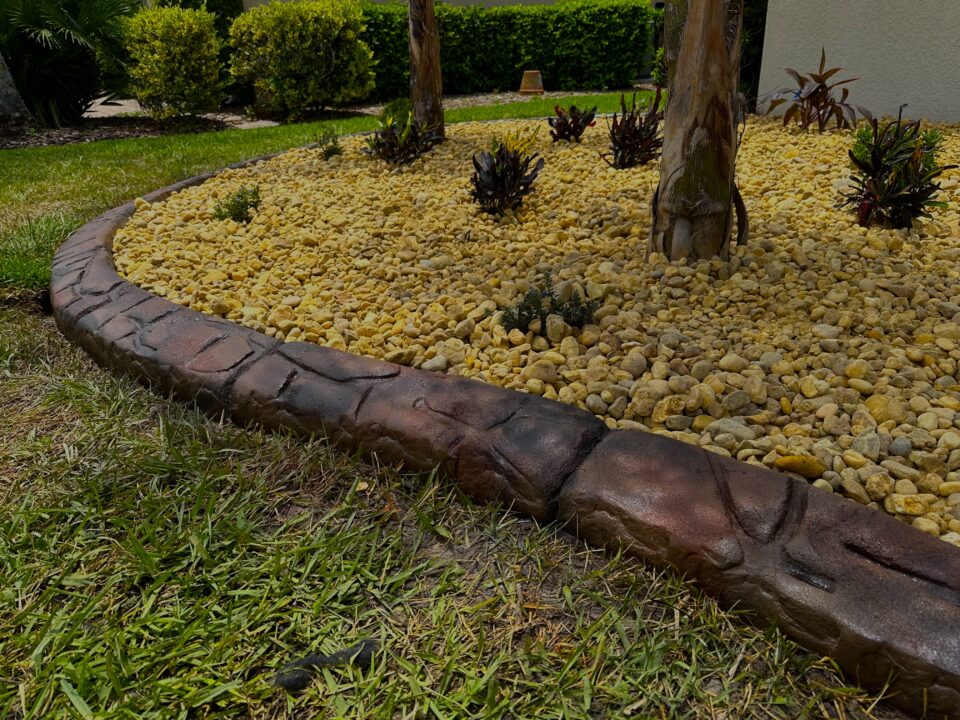
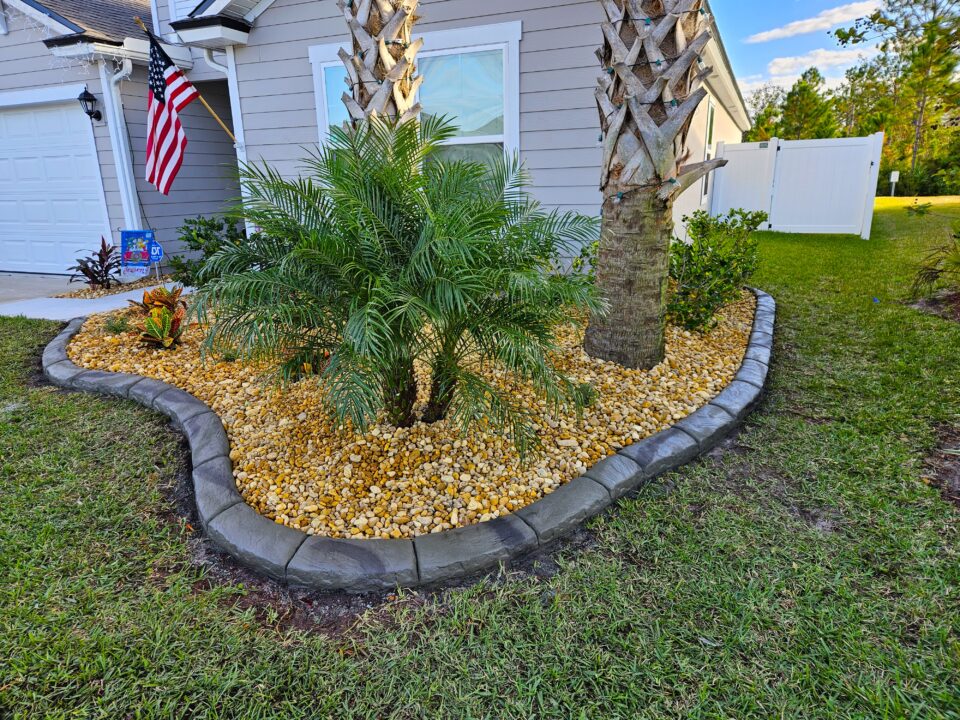
- Define the edge. Cut a clean bed edge or make sure your curbing or border is clear. Mulch should sit slightly below the top of the edge so it does not wash onto the grass.
- Water first if the soil is dry. Laying mulch over bone dry sand traps dryness in. A light watering beforehand helps.
- Spread to 2 to 3 inches. Use a rake or your hands to keep the depth even. Too thin and weeds push through. Much deeper and roots can struggle for air and water.
- Pull it back from stems and trunks. Leave a few inches of bare space around shrubs and a wider gap around trees and palms. Mulch piled against bark holds moisture there and can lead to rot and pest problems.
- Tidy up. Blow mulch off walkways, driveways and curbing so the bed edge reads clean.
Figuring out how much you need
Bagged mulch is usually sold by the cubic foot, and bulk mulch by the cubic yard. To estimate, measure each bed’s length and width in feet, multiply them for square footage, then multiply by the depth in feet. A 3 inch layer is 0.25 feet. Divide cubic feet by 27 to get cubic yards.
Curved and irregular beds are trickier, so it helps to break them into rough rectangles and circles. Our guide on measuring garden beds before ordering mulch or stone walks through that in more detail.
When to refresh mulch in Palm Coast
Mulch breaks down faster here than in cooler climates, thanks to heat, humidity and summer rain. Most beds benefit from a top up once or twice a year. A few times that tend to work well:
- Late winter or early spring, before the growing season and the dry spring stretch, when holding moisture really counts.
- Early summer, before the heaviest heat, if the layer has thinned out.
- After the heavy rains or a storm, if mulch has washed out of the beds.
Rather than going by the calendar alone, check the depth. If you can see soil through the layer, or if it has thinned to about an inch, it is time.
Common mulching mistakes to avoid
- Mounding mulch up around tree trunks in a cone shape.
- Piling fresh mulch on top of old mulch year after year until the bed is far too deep.
- Skipping the weeding step and mulching over growing weeds.
- Letting mulch spill over curbing and edging onto the lawn.
- Using plastic sheeting underneath, which blocks water and air from reaching roots.
Frequently asked questions
How deep should mulch be in Florida flower beds?
About 2 to 3 inches is the usual target. That is deep enough to hold moisture and block weeds, while still letting water and air reach the roots.
Does mulch attract termites?
Mulch does not create termites, but any moist organic material near a house can be attractive to them. Many homeowners keep a mulch-free strip of several inches next to the foundation, and you can ask a licensed pest professional for guidance on your home.
Should I remove old mulch before adding new mulch?
Not always. If the old layer is thin and broken down, you can add fresh mulch on top. If it is already deep or has formed a hard crust, rake some out or loosen it first.
Mulch installation is one of the everyday jobs our team at Udell’s Landscape Services handles for homes across Palm Coast and Flagler County, along with planting, our other landscaping services and full landscape design in Palm Coast. If you would like us to take care of your beds, you can request a free estimate or give us a call at (386) 931-6539.