Landscape Design for Palm Coast Curb Appeal
May 4, 2026How to Choose Landscaping That Complements Your Palm Coast Home
May 13, 2026Low voltage landscape lighting runs on 12 volts through a transformer that plugs into an outdoor outlet, which makes it safer, cheaper to operate and easier to adjust than line voltage lighting. For Flagler County homes, it is the practical way to light walkways, steps, driveways, palms and the front of the house so the property is safer to walk at night and looks welcoming from the street. With LED bulbs and corrosion-resistant fixtures, a well-planned system holds up to our heat, rain and salt air.
How a low voltage system works
It helps to know the parts before deciding where lights should go. A typical system has four pieces:
- Transformer. Steps household power down to 12 volts. It usually mounts near an exterior GFCI outlet and includes a timer, a photocell that turns lights on at dusk, or both.
- Low voltage cable. Runs from the transformer to each fixture. Because the voltage is low, it is buried at a shallow depth in beds and lawn rather than in conduit like household wiring.
- Fixtures. Path lights, spotlights, well lights, wall washers and small step lights, each designed for a different job.
- LED lamps. Use a fraction of the power of old halogen bulbs, run cooler and last much longer, which means fewer trips through the shrubs to change bulbs.
Because nothing runs at household voltage once it leaves the transformer, fixtures can be moved as plants grow. That flexibility matters in Florida, where a small palm can double in size in a few seasons.
Where fixtures do the most good
Good lighting is about placing a modest number of fixtures with purpose, not lighting every square foot. Here is where we usually start on a Flagler County home.
Walkways and entry
Path lights along the front walk, staggered from side to side, help guests see the route to the door without creating a runway look. Light any step, threshold or change in level, since that is where people trip.
Driveway edges
A few low fixtures along the driveway help with backing out at night and mark the edge so cars stay off the lawn and beds. In many Palm Coast neighborhoods with swales and no streetlights, this makes a real difference.
Palms and specimen trees
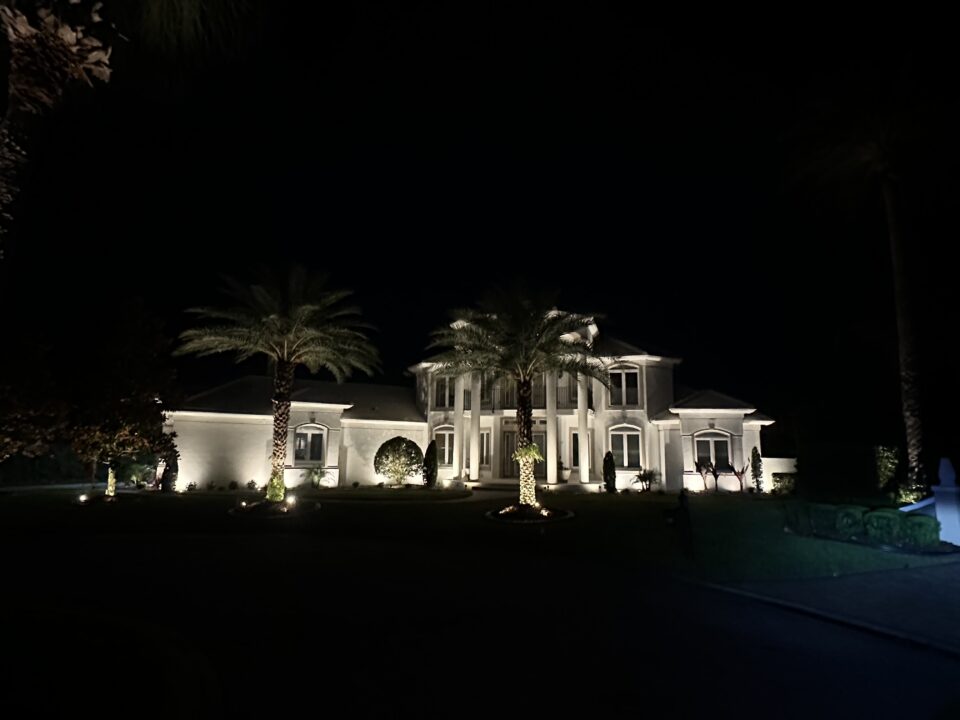
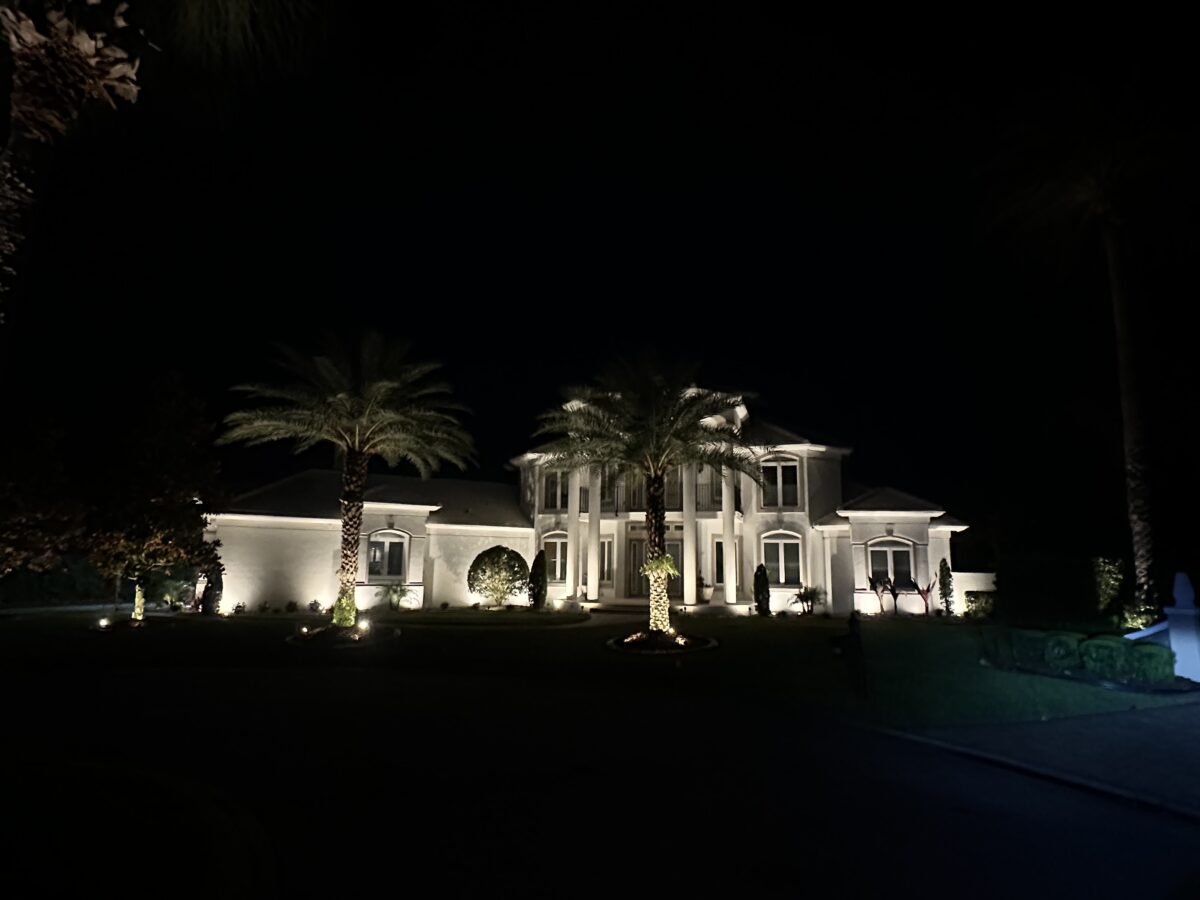
Uplighting a cabbage palm or a live oak gives the yard depth after dark. One or two well-aimed spotlights at the base of the trunk are often enough.
The front of the house
Soft wall washing between windows shows off the architecture and makes the home look occupied. Aim fixtures so light does not shine into bedrooms or neighbors’ windows.
For more placement ideas, read our post on lighting for trees, beds and pathways.
Why low voltage suits Florida yards
Several things about our climate and soil make low voltage a better match than other options.
- Safety around water. Yards here get soaked often, from afternoon storms and irrigation. A 12 volt system greatly reduces shock risk compared with household voltage outdoors.
- Sandy soil is easy to work in. Shallow cable runs are quick to install and easy to reroute when you redo a bed.
- Storm season recovery. If a fixture is damaged by debris or a falling branch, it can be replaced without an electrician rewiring a circuit.
- Lower running cost. LED fixtures draw very little power, so lights can stay on dusk to late evening without much impact on your bill.
Solar stake lights are tempting, but under heavy tree canopy and through cloudy stretches of summer, they often fade early in the night. A wired low voltage system gives steady, predictable light.
Choosing fixtures that last near the coast
Salt air is the biggest enemy of outdoor lighting in Flagler County, especially east of US 1 and close to the beach. Cheap painted aluminum fixtures can pit, peel and corrode quickly.
- Solid brass and copper fixtures develop a natural patina but hold up well to salt and moisture.
- Use waterproof, gel-filled wire connectors rather than simple twist or pierce connectors.
- Choose sealed LED fixtures rated for wet locations.
- Warm white light, around 2700K to 3000K, looks natural on plants and stucco and is easier on the eyes than bright blue-white.
If your home is on the beach, Flagler County has sea turtle lighting rules for beachfront properties during nesting season. Lights visible from the beach may need to be shielded, low, and turtle-friendly. Check the current county requirements before planning lighting on the ocean side of the house.
Keeping the system working
Low voltage lighting is low maintenance, not no maintenance. A short check a couple of times a year keeps it looking right.
- Walk the yard after dark and note any fixtures that are out, dim or aimed wrong.
- Trim plants that have grown over path lights or are blocking uplights.
- Reset the timer when daylight saving time begins and ends if your transformer does not have a photocell.
- After a big storm, look for fixtures that were knocked over or cables exposed by washouts.
HOA communities sometimes have rules on fixture style, brightness or placement near the street, so check with your HOA before installing.
Frequently asked questions
Do I need an electrician for low voltage landscape lighting?
The low voltage wiring and fixtures typically do not require an electrician. You do need a properly installed outdoor GFCI outlet for the transformer, and if one is not available, a licensed electrician should add it.
How long do LED landscape lights last?
LED lamps last many years longer than halogen bulbs under normal use. In practice, fixtures near the coast are more likely to need attention from corrosion or physical damage than from a burned-out LED.
Can I add more lights later?
Usually, yes. Sizing the transformer with some extra capacity at the start makes it easy to add fixtures when new beds or trees go in.
Udell’s Landscape Services designs and installs landscape lighting as part of our landscape design work in Palm Coast and across Flagler County, with more than 20 years of local experience behind it. If you would like ideas for your property, request a free estimate or call (386) 931-6539.