How to Tell if Palm Coast Landscaping Advice Is Actually Useful
May 4, 2026Palm Coast Landscape Design for Front Yards
May 4, 2026The best way to plan landscape lighting for trees, beds and pathways in Palm Coast is to treat them as three separate layers: uplights to give trees height, soft low lights to give beds texture, and path lights spaced for safe walking. Each layer has a different job, so each uses a different fixture and brightness. When the three are balanced, the yard has depth after dark instead of a few bright spots surrounded by black.
Below we break down each layer, then cover the practical details that matter in Flagler County, like salt air, summer storms and HOA rules.
Start with a quick nighttime look
Before choosing a single fixture, walk the property after sunset. Daytime planning misses a lot. Notice where you actually walk, which trees stand out against the sky, where the porch light already reaches, and which windows look out over the yard. Light that looks good from the street but shines straight into a bedroom window is not a win.
Our post on a nighttime landscape lighting walkthrough goes deeper on what to look for on that first evening.
Layer one: lighting trees and palms
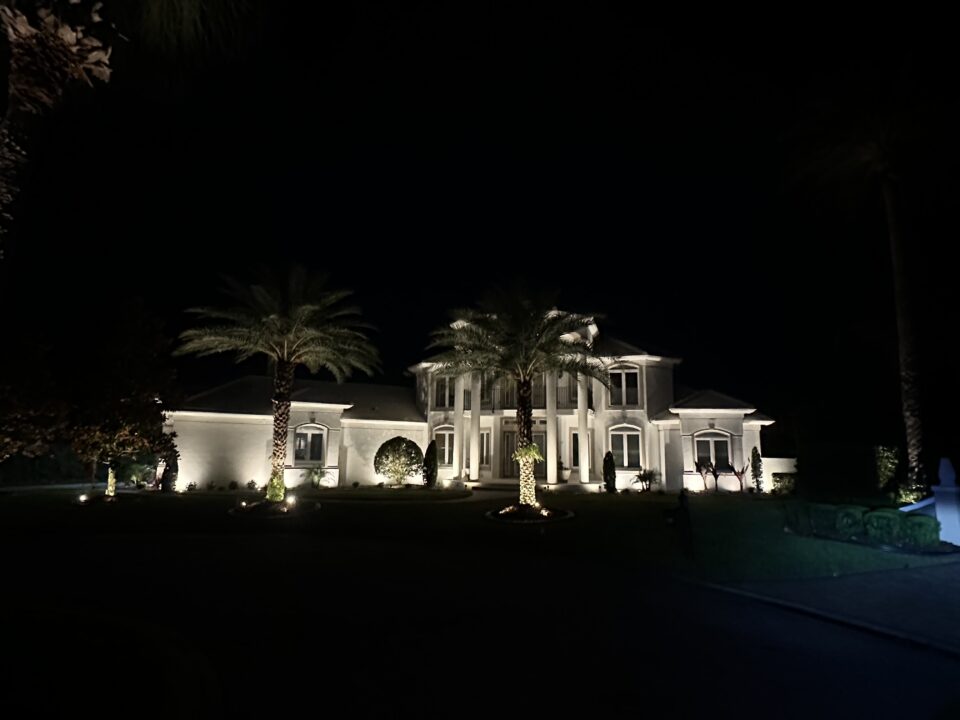
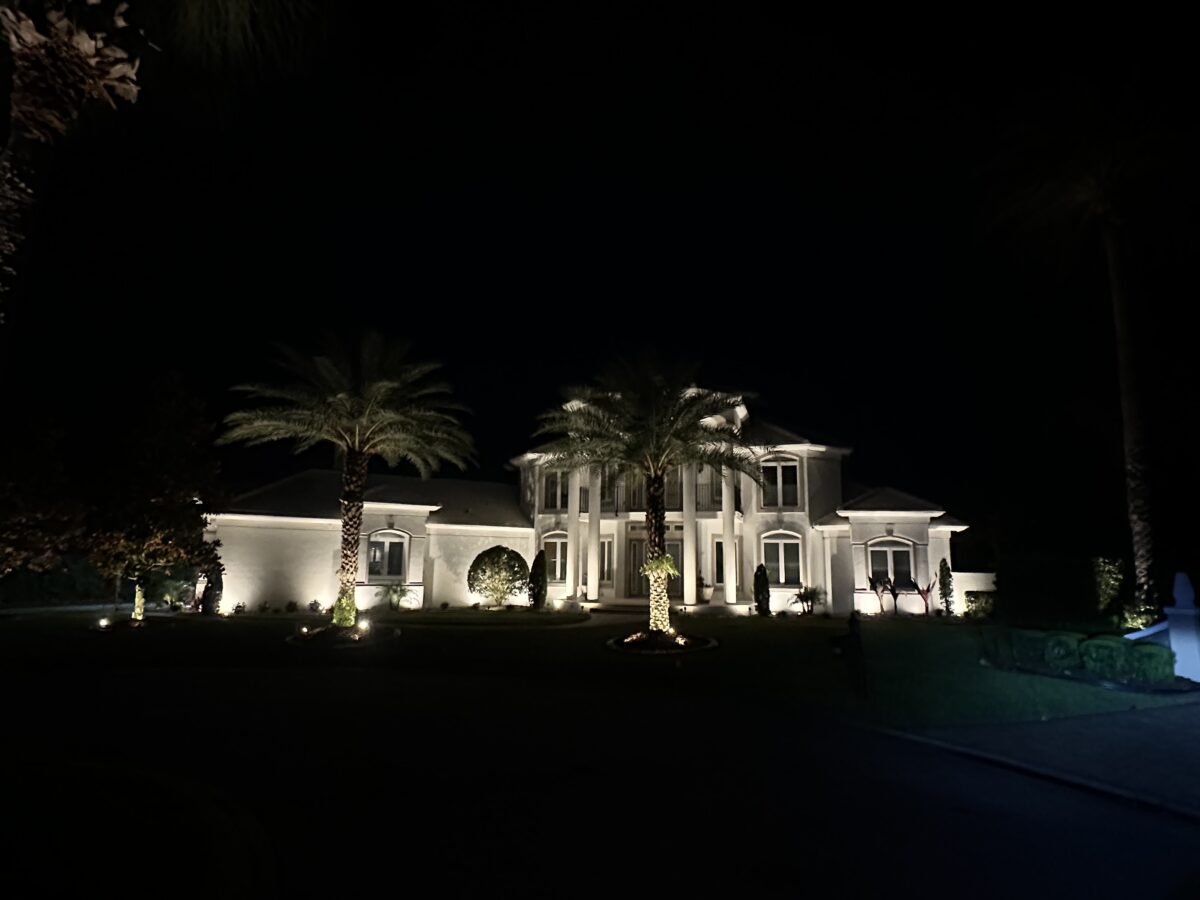
Trees are the tallest elements in most yards, so lighting them is what gives the property a sense of scale at night. The usual tool is an uplight, a fixture set at ground level and aimed up into the canopy or along the trunk.
- Palms: A single uplight close to the base, aimed up the trunk, shows off the trunk texture and catches the underside of the fronds. Tall palms may need a narrower beam to reach the head.
- Live oaks and broad canopy trees: Two or more fixtures set farther out from the trunk with wider beams light the canopy evenly instead of making a bright stripe on one side.
- Small ornamental trees: One fixture is often enough. Too much light on a small tree flattens it.
Pick one or two feature trees rather than lighting every tree on the lot. A yard where everything is lit has no focal point.
Layer two: lighting planting beds
Beds need gentle light that shows texture and shape without glare. This is where many homeowners overdo it. A bed does not need to be bright, it needs to be visible.
Good approaches for beds include:
- Grazing: Placing a fixture close to a textured wall or a row of shrubs and aiming it up at a steep angle so the light skims the surface.
- Accent lighting: A small, low output spotlight on one specimen plant, like a sago, a clump of muhly grass or a large agave.
- Wash lighting: A wider, softer beam that lights a section of hedge or a bed against the house evenly.
Keep in mind that plants grow. A fixture tucked neatly beside a young shrub can be buried within a year or two. Leave room around fixtures, and plan on adjusting aim as the bed fills in.
Layer three: lighting pathways and steps
Path lighting is the most practical layer, because its main job is safety. You want to see the edges of the walk, any steps, and changes in surface without feeling like you are walking down a runway.
- Stagger path lights on alternating sides of the walk rather than lining them up in pairs.
- Space them so the pools of light just overlap or nearly touch. Gaps are fine on a straight walk, but steps and turns should always be lit.
- Choose fixtures with a shielded top that throw light down, not into people’s eyes.
- Keep them back from the edge of the walk so mowers, trimmers and feet do not knock them over.
Our post on outdoor lighting ideas for safer walkways and driveways has more on this layer specifically.
Fixture types at a glance
| Area | Typical fixture | Light style |
|---|---|---|
| Trees and palms | In-ground or stake-mounted uplight | Narrow to medium beam aimed upward |
| Beds and shrubs | Small spotlight or wash light | Low output, soft and angled |
| Walkways and steps | Path light or step light | Downward, shielded, evenly spaced |
Details that matter in Palm Coast
Our climate is hard on outdoor electrical equipment, so a few choices make a big difference in how long a system lasts.
- Low voltage systems: Most residential landscape lighting runs on a low voltage transformer, which is safer to work around in beds and easier to adjust. Any connection to household power should be handled by a licensed electrician.
- Materials: Closer to the coast, salt air corrodes cheap metal fixtures quickly. Brass, copper and quality composite fixtures tend to hold up better than thin painted aluminum.
- Water: Summer rain and irrigation spray soak everything. Use connectors rated for direct burial and outdoor wet locations, and keep sprinklers from blasting fixtures directly.
- Storms: During hurricane season, stake lights and loose fixtures can get knocked around or buried. A quick check after each major storm catches problems early.
- Neighbors and wildlife: Aim lights so they stay on your property. Homes near the beach should also be aware that local rules limit lighting visible from the beach during sea turtle nesting season, so check your city’s requirements if you are close to the dunes.
- HOA rules: Some communities set limits on fixture style, brightness or color temperature. Check with your HOA before installing.
Our landscape lighting page explains how we design and install systems for local homes.
Frequently asked questions
How many lights does a typical front yard need?
It depends on the size of the yard and how many features you want to highlight. Many front yards look balanced with one or two lit trees, a few soft accents in the beds and enough path lights to make the walk safe.
What color of light looks best on plants?
Warm white light usually looks the most natural on homes and foliage in our area. Very cool, blue tinted light can make plants look washed out and the yard feel harsh.
Can landscape lighting be put on a timer?
Yes. Most low voltage transformers can run on a timer, a photocell that turns lights on at dusk, or both. That way the system comes on automatically and you do not have to think about it.
Udell’s Landscape Services is locally owned in Palm Coast, and owner Corey Udell has more than 20 years of experience with lighting and landscape design in Palm Coast and throughout Flagler County. If you would like help planning lights for your trees, beds and paths, you can request a free estimate or call (386) 931-6539.