Spring Landscape Refresh Ideas for Palm Coast Properties
April 22, 2026Storm Debris Removal for Flagler County Yards
May 4, 2026Good landscape lighting does two jobs at once: it shows off your plants and home after dark, and it helps people see steps, paths, edges and doors so nobody trips or fumbles for keys. The trick is to light safety areas first with soft, even light, then add a few accent lights for beauty, while keeping glare out of everyone’s eyes. In Palm Coast, it also means choosing fixtures that hold up to humidity, rain and, near the beach, salt air.
Safety first: the places that always need light
When we plan a lighting layout, we start by walking the property at dusk and asking where someone could stumble or feel uneasy. On most Palm Coast homes, the list looks something like this:
- Front walkway from the driveway to the door
- Steps and changes in level, including the single step at a porch or lanai that people forget about
- The front door and house numbers, so guests and emergency crews can find you
- Driveway edges, especially where the driveway meets beds or a swale
- Side yards and gates where trash cans, AC units and hoses live
- Pool and dock areas, where wet surfaces and water make good visibility important
The goal in these spots is even light that shows the ground clearly. Low path lights spaced so their pools of light overlap a little, or step lights set into risers, work better than one bright floodlight that throws harsh shadows. Our post on outdoor lighting for safer walkways and driveways covers spacing and placement in more detail.
Beauty second: choosing what to highlight
Once the practical areas are covered, accent lighting gives the yard depth and character at night. Less is usually more. A few well-chosen focal points look better than lighting every plant in the bed.
Good candidates in Flagler County yards include:
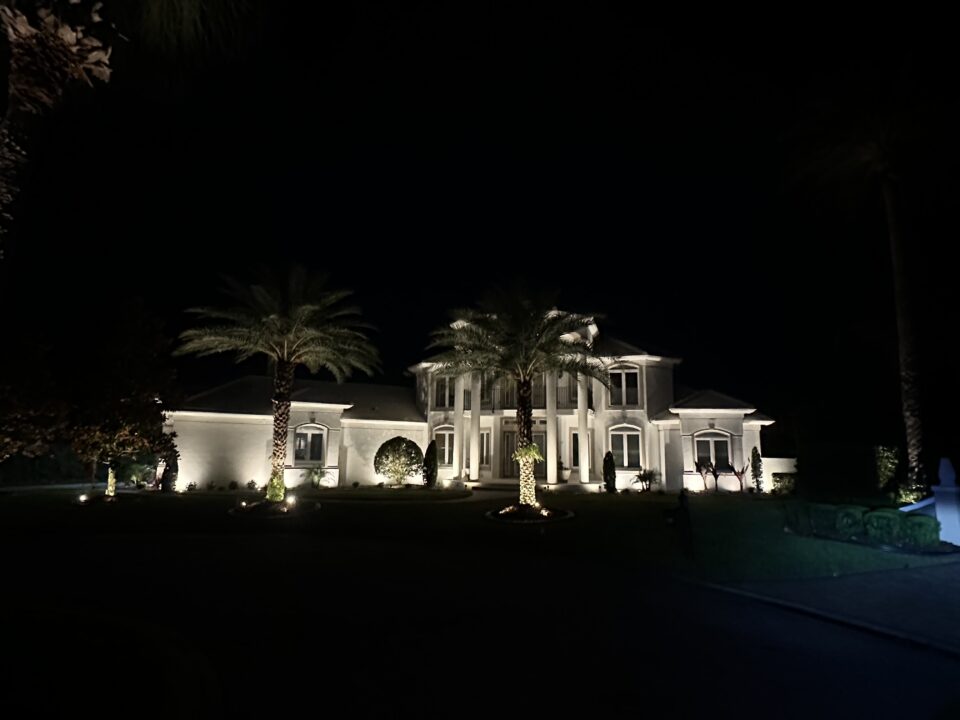
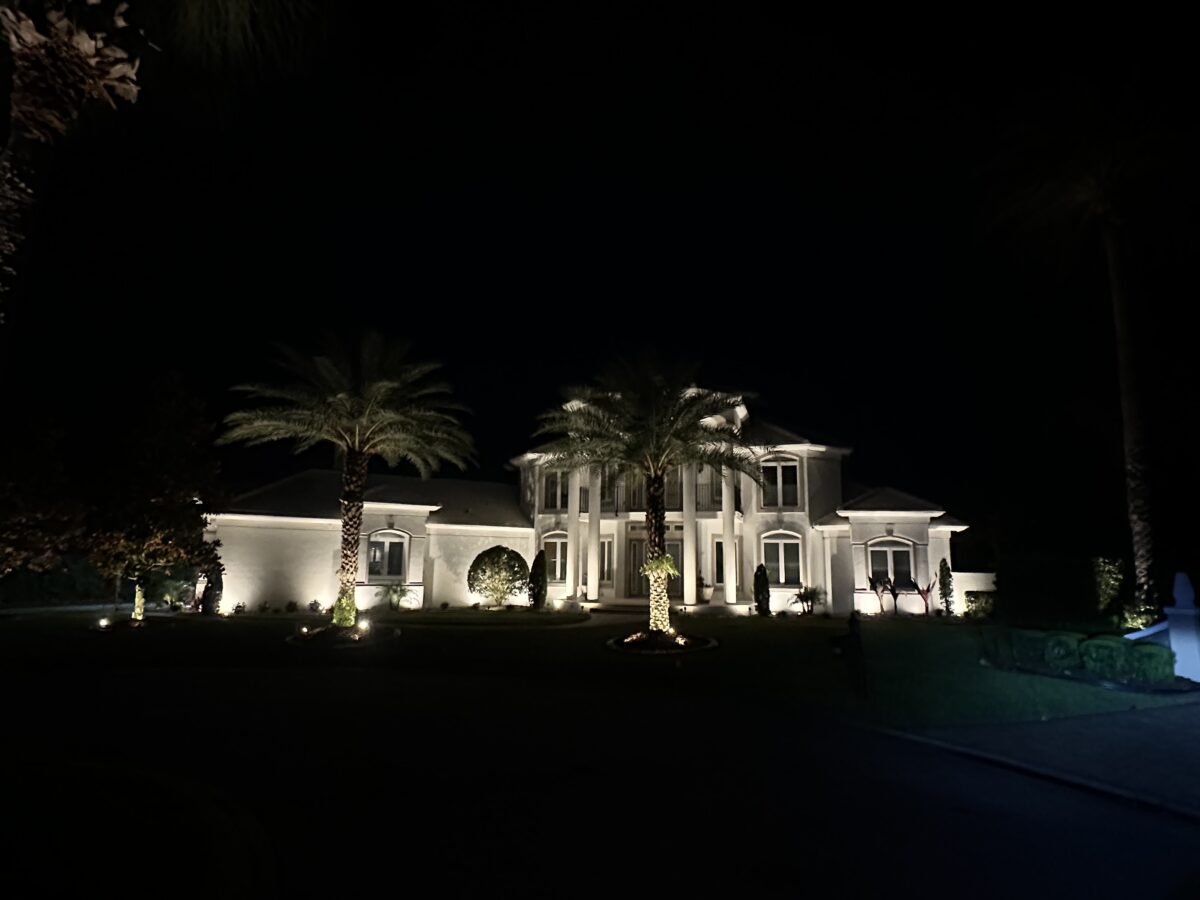
- Palms. Uplighting from the base shows off the trunk and fronds against the night sky.
- Specimen trees like a live oak or a sculptural shrub with an interesting shape.
- Textured walls such as stone, stucco or brick, which look rich with light grazing across them.
- Architectural features like columns, entry arches or a front gable.
Mixing techniques keeps it interesting. Uplighting adds drama to trees. Downlighting from a branch mimics moonlight and spreads gentle light over a patio. Wall washing gives a soft glow to the front of the house. For more on this, see lighting trees, beds and pathways in Palm Coast.
Where beauty and safety work together
The best lighting plans do not treat these as separate projects. A lot of fixtures do both jobs.
| Fixture or technique | Safety benefit | Beauty benefit |
|---|---|---|
| Path lights along a walkway | Shows the edges of the path and any uneven spots | Highlights the bed plantings beside the walk |
| Downlights from a tree | Spreads wide, soft light over lawns and patios | Creates a natural, moonlit look with leaf shadows |
| Wall wash near the entry | Lights the door area and house numbers | Gives the front of the home a warm glow |
| Uplight on a palm by the driveway | Marks the driveway entrance from the street | Turns the palm into a nighttime focal point |
Avoiding glare, light spill and other common mistakes
Badly placed lighting can actually make things less safe. Bright fixtures pointed toward eyes cause glare, which makes it harder to see what is beyond them. A few habits help:
- Aim lights at the object, not at the viewer. Shielded or hooded fixtures help.
- Use warm white light, which feels more natural and inviting around a home than very cool, blue-white light.
- Keep brightness moderate. Your eyes adjust quickly in the dark, so a little light goes a long way.
- Be a good neighbor. Avoid lights that shine into bedroom windows next door.
- Do not create a runway. Path lights lined up in a perfectly straight row can look stiff. Staggering them a bit looks more natural.
If your home is on or near the beach, there is another consideration. Flagler County has sea turtle lighting rules for coastal properties during nesting season, which limit light that is visible from the beach. Check the current county rules before adding lights on the ocean side of the house.
Choosing fixtures that last in our climate
Humidity, sprinklers, heavy summer rain and salty breezes are hard on outdoor electrical gear. Low-voltage LED systems are popular here because they use little energy, run cool and are safer to work around than line-voltage lighting.
When comparing fixtures, look at:
- Material: solid brass and copper hold up well near salt air. Cheap aluminum or plastic fixtures often corrode or crack.
- Sealed connections: waterproof wire connectors keep moisture out of splices.
- Smart controls: a timer or photocell turns lights on at dusk and off at a set time, so you never have to think about it.
- Room to grow: a transformer with some extra capacity lets you add fixtures later as plants fill in.
Our landscape lighting page explains how we plan and install systems for homes here.
Frequently asked questions
How many landscape lights does a typical front yard need?
It depends on the length of your walkway, the number of steps and how many features you want to highlight. The best approach is to cover safety areas first, then add just enough accent lights to give the yard depth.
Is low-voltage lighting bright enough for safety?
Yes. Modern LED fixtures provide plenty of light for paths, steps and entries. Proper placement and spacing matter more than raw brightness.
Will landscape lighting survive a Florida summer?
Quality fixtures with sealed connections hold up well to heat, rain and humidity. Near the coast, brass or copper fixtures are a smart choice because they resist corrosion from salt air.
If you would like help planning lighting that looks good and keeps your paths safe, Udell’s Landscape Services installs landscape lighting for homes throughout Palm Coast and Flagler County. Learn more about our landscape design in Palm Coast, request a free estimate, or call (386) 931-6539.