A Nighttime Landscape Lighting Walkthrough Before Fall
September 11, 2026Landscaping in Phases: A Fall Project Plan for Palm Coast
September 16, 2026To figure out how much mulch or stone to order, measure the actual planting-bed area in square feet, multiply by the finished depth in inches, divide by 12 to get cubic feet, and divide by 27 to get cubic yards. Then subtract what is already in the bed. Treat the result as a starting estimate and confirm the installation depth with whoever is doing the work.
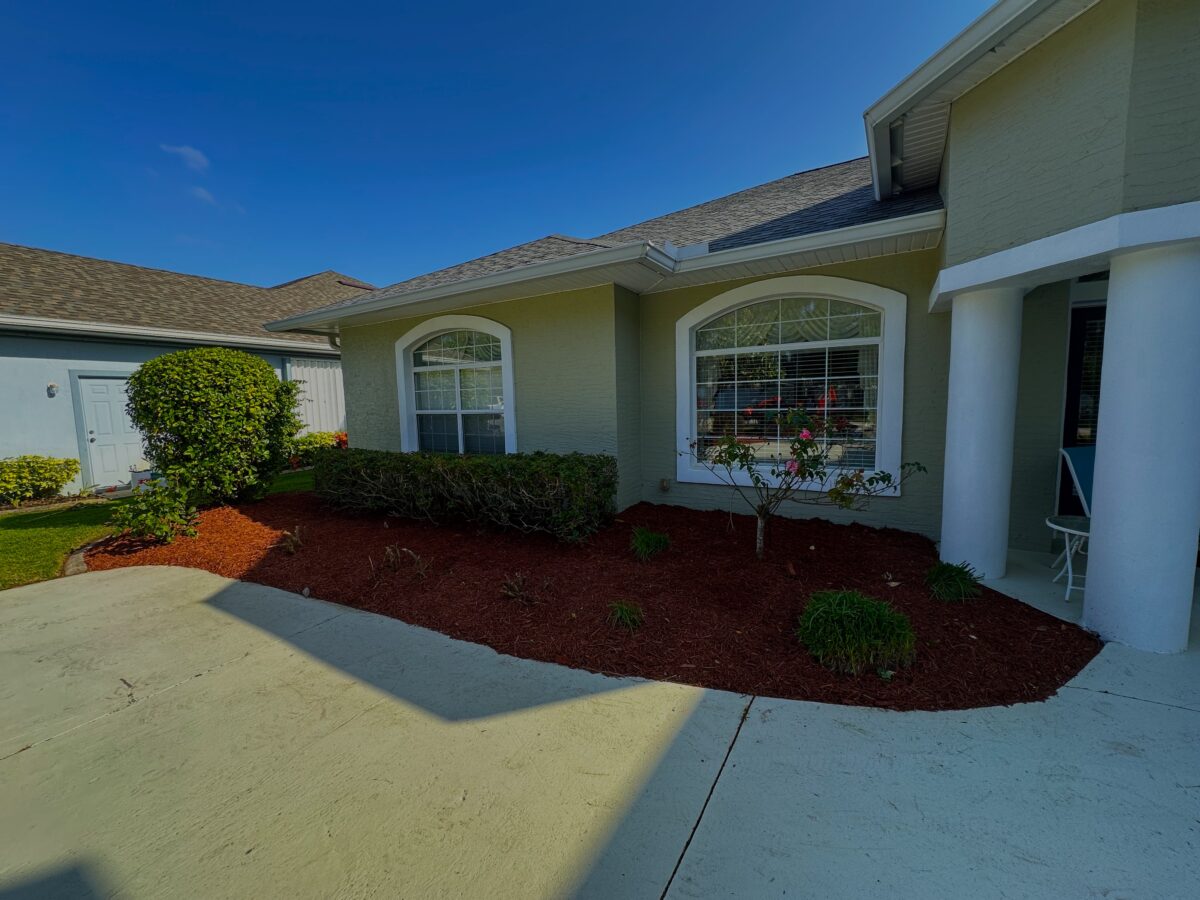
A Palm Coast bed with broad curves can look much larger than its usable surface, and old material changes how much you really need. A few minutes with a tape measure and a sketch can save you from a pile of extra stone in the driveway or a second trip to the supplier.
Break curves into smaller shapes
Most beds are not neat rectangles, so the easiest approach is to break them into shapes you can measure. Start with a rough sketch on paper, then:
- Divide the bed into rectangles and rough triangles.
- For each rectangle, multiply length by width.
- For each triangle, multiply length by width and take half.
- Add the areas together.
- Subtract large spaces that will not get material, such as stepping pads, AC pads or a section of paving.
Label every measurement in feet. Mixing feet and inches is one of the most common reasons a calculation comes out wrong. If a measurement is 8 feet 6 inches, write it as 8.5 feet.
For long curved borders, it can help to measure the width at several points along the curve and use an average. It will not be perfect, but it gets you much closer than guessing from the driveway.
Convert area into volume carefully
Once you have the area, the math is simple. For a purely mathematical example, 120 square feet covered to a depth of 2 inches needs 20 cubic feet: 120 multiplied by 2, then divided by 12. Divide cubic feet by 27 for cubic yards, which comes to a little under three-quarters of a yard in this example.
A few things to keep in mind when you use these numbers:
- This example explains the arithmetic, not the right depth for every material or planting.
- Bagged mulch and stone are sold in different bag sizes, so check the label for cubic feet per bag.
- Bulk suppliers usually sell by the cubic yard, and some sell stone by weight instead.
- Organic mulch settles after it is spread, so a freshly installed layer will look a bit deeper than it ends up.
Stone and organic mulch also behave differently in a bed, so they are not interchangeable even when the volume works out the same. Review our mulch and stone comparison before deciding which one belongs in each area.
Account for material already in the bed
Unless you are starting with bare soil, there is probably some material left from the last installation. Check the depth in several locations instead of measuring only the thinnest spot. Beds often wear thin near the lawn edge and under downspouts while staying thick near the house.
Depth matters for plant health, not just appearance. The UF/IFAS Florida-Friendly Landscaping guidance on mulch generally suggests a layer of about 2 to 3 inches of organic mulch, cautions against piling it deeper, and advises keeping mulch pulled back from plant trunks and stems. Mulch heaped against trunks can hold moisture against the bark and invite problems.
That means a fresh top dressing should not simply repeat the original installation volume. If the bed still has an inch or more of usable mulch, you may only need enough to bring it back to the planned depth. In some cases old, compacted material should be loosened or removed first.
Include access and cleanup in the scope
Material quantity is only part of the job. Before you order, write down a few practical details:
- Gate widths and whether a wheelbarrow or small machine can get through
- The distance from where the material will be dropped to the farthest bed
- Whether old mulch, stone or weed fabric needs to be removed
- How driveways, pavers and pool decks will be protected during delivery and spreading
- Who clears leftover material when the work is done
These details affect labor as much as material, which is why a quantity-only quote can be hard to compare with one that includes full preparation. Our mulch installation guide explains how bed preparation, such as weeding and edging, fits into the finished result. If you are planning a broader refresh at the same time, our landscaping services page outlines the kinds of bed and planting work that can be handled together.
What should the estimate list?
Whether you hire help or compare a few proposals, a clear estimate makes decisions easier. Look for:
- The measured bed area
- The material name, color and type
- The planned finished depth
- The estimated quantity, in bags, cubic yards or tons
- Any removal of old material, weeds or fabric
- How changes found during preparation will be handled
When the bed area and depth are written down, it is much easier to compare proposals fairly and avoid buying material before the site has been looked at. Clean measurements are a small but useful part of good landscape design in Palm Coast, because they keep the plan grounded in the real size of your beds.
Frequently asked questions
How do I convert square feet of bed into cubic yards of mulch?
Multiply the square feet by the depth in inches, divide by 12 to get cubic feet, then divide by 27 to get cubic yards. For example, 120 square feet at 2 inches deep is 20 cubic feet, or a little under three-quarters of a yard.
Should I order extra material just in case?
A small cushion can help with uneven ground, but large overages usually end up sitting unused. Accurate measurements and a check of existing depth are the best way to keep the order close to what the bed needs.
Do I need to remove old mulch before adding new mulch?
Not always. If the old layer is thin and in decent shape, a top dressing may be enough. If it is thick, compacted or piled against plant stems, some removal or loosening is usually a better choice.
Can I use the same calculation for stone?
The volume math is the same, but stone is often sold by weight, so you may need the supplier’s conversion from cubic yards to tons. Ask what depth is recommended for the specific stone you choose.
If you would rather have someone measure and plan it with you, Udell’s Landscape Services helps homeowners across Palm Coast and Flagler County with bed refreshes of all sizes. Send a sketch and a few photos when you request a free estimate, or call (386) 931-6539.