Small Yard Landscape Design in Palm Coast: Making Space Count
October 19, 2026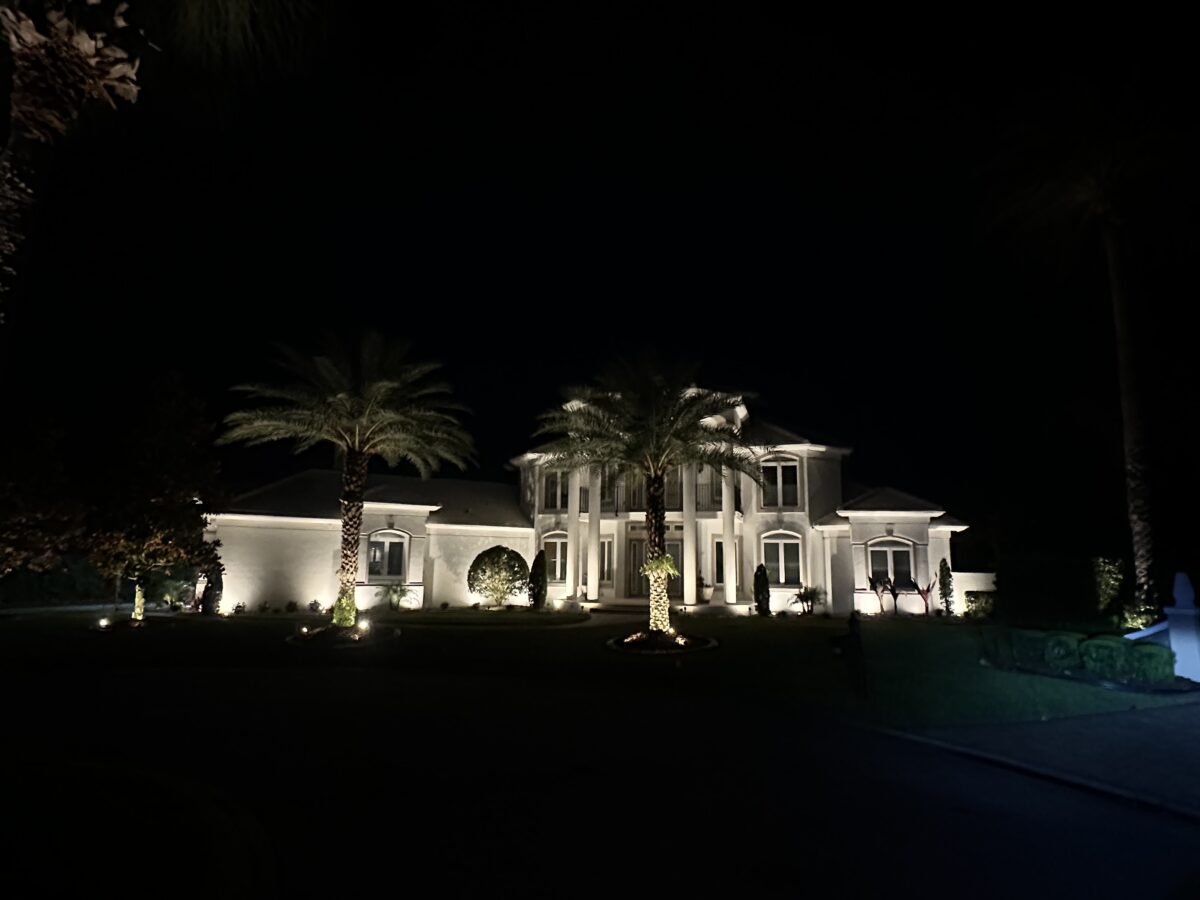
Landscape lighting in Palm Coast earns its keep in late fall and winter, when the sun sets before most people get home from work. The best time to plan it, check it or add to it is right around the end of daylight saving time, because your yard suddenly spends more of the evening in the dark. A good plan lights the paths you walk, the entry you use and a few features worth seeing, and lets the rest of the yard stay soft and dark.
Daylight saving time ends on Sunday, November 1, 2026, and the evenings in Flagler County get short fast after that. Here is how we think about lighting a yard for the darker months, whether you already have fixtures in the ground or you are starting from nothing.
Why does landscape lighting matter more in fall and winter?
In June, a Palm Coast evening stays bright well past dinner. By December, it can be dark before 6 p.m. That means the drive home, the walk from the car to the door, taking the trash cans out and letting the dog out all happen in the dark for a few months.
It is also the most pleasant time of year to be outside here. Cooler, drier evenings are when people actually use the lanai, the fire pit and the backyard. Lighting turns those hours into usable time instead of a black wall past the screen.
And it is when your landscape gets seen. Neighbors driving by, guests coming over for the holidays and anyone looking at the house after work all see it at night. A yard that looks finished in daylight can disappear completely after sunset without a few well placed lights.
What should you light first?
If you are starting fresh, light the things you use before the things you admire. A practical order that works for most Palm Coast homes:
- The walk from the driveway to the front door. Steps, turns and any change in level come first. Low path lights along the edge of the walk, spaced so the pools of light connect without looking like a runway, usually do the job.
- The entry. Soft light on the front door area and the plants beside it makes the house feel welcoming and helps guests find the door.
- The house number. It sounds small, but being able to read the address from the street at night helps visitors and delivery drivers.
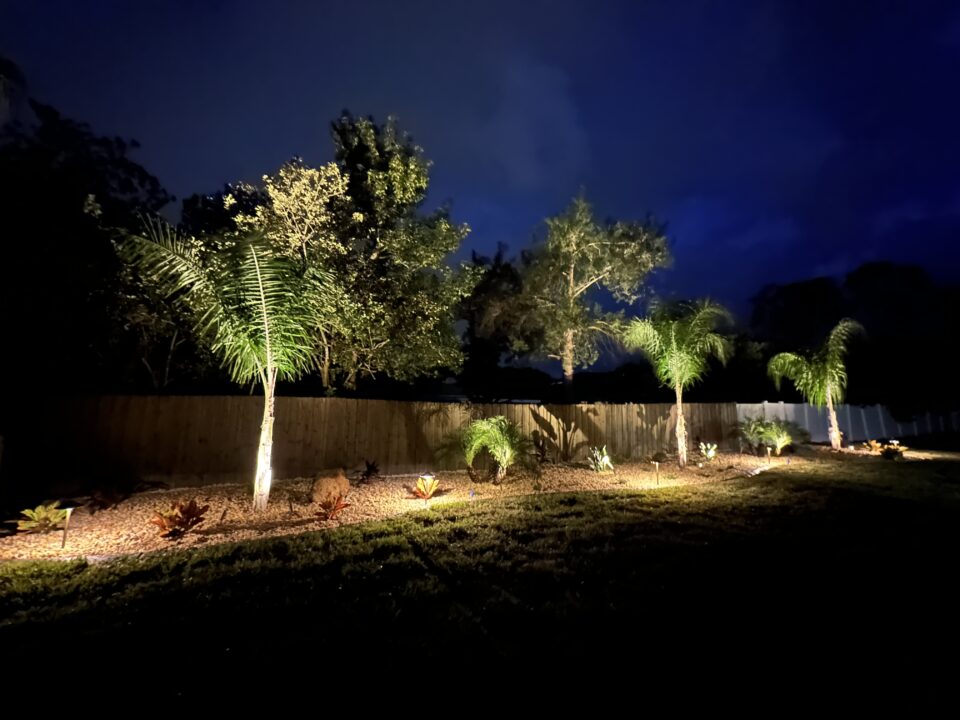
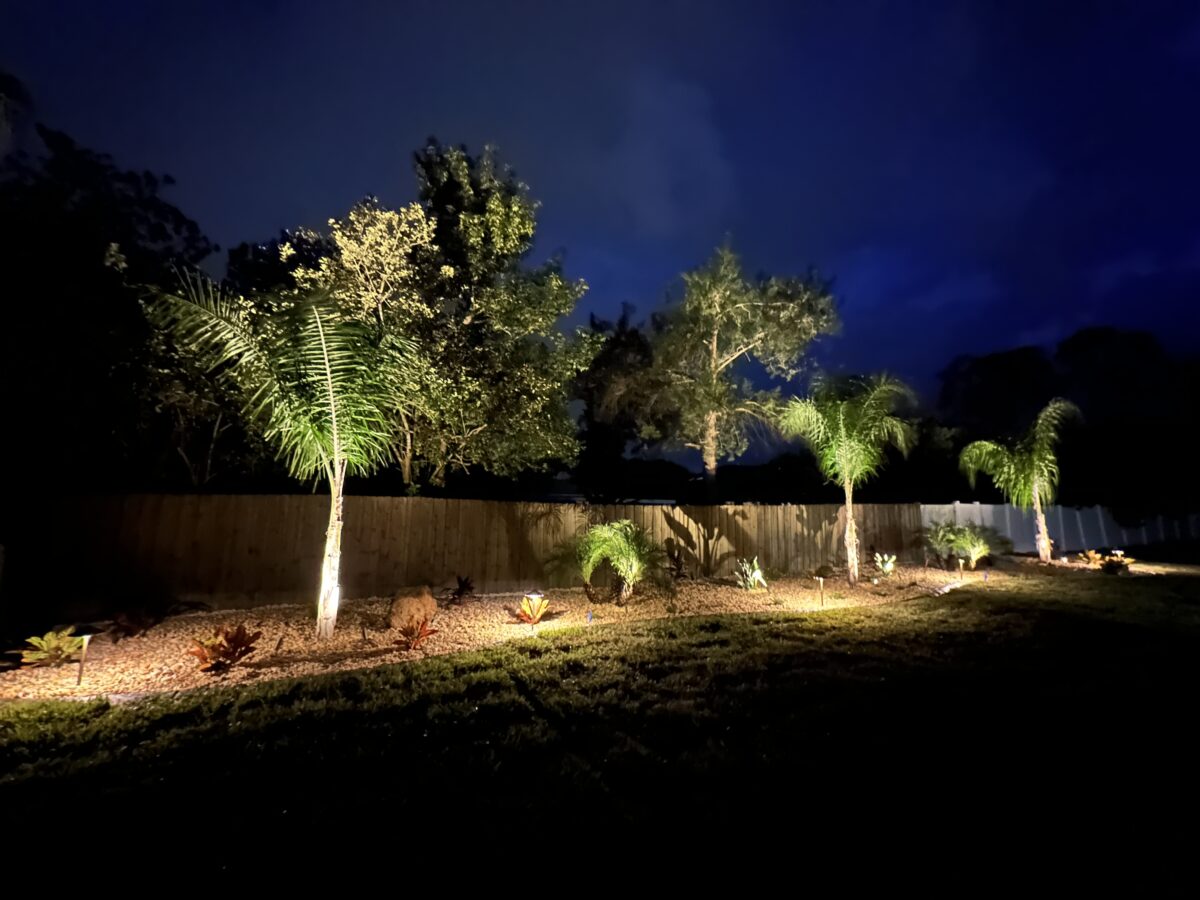
- One or two focal points. A palm, a specimen tree or a textured wall lit from below gives the whole front yard depth.
- The backyard spaces you use. Steps off the lanai, a path to the side gate, a seating area or a garden bed you can see from inside.
You do not need all five at once. Many homeowners start with the walk and entry and add focal lighting later. If you want ideas on where those lights land in a front yard, our post on outdoor lighting ideas for Palm Coast front yards walks through it.
Should you reset timers after the time change?
Yes, and it is the easiest thing to forget. How your lights turn on makes a big difference in the darker months:
| Control type | What happens in November | What to do |
|---|---|---|
| Basic clock timer | Keeps its old schedule, so lights can come on an hour late or after dark | Reset the clock and adjust the on time to match earlier sunsets |
| Photocell (dusk to dawn sensor) | Turns on by itself when it gets dark | Make sure plants or mulch have not covered the sensor |
| Photocell plus timer | Comes on at dusk, shuts off after a set number of hours | Check that the off time still fits your evenings |
| Smart or app controlled | Usually follows local sunset automatically | Confirm the schedule and that it is still connected to Wi-Fi |
A photocell is one of the simplest upgrades if you are tired of resetting a clock twice a year. Just keep it where it can actually see the sky, not tucked behind a shrub that will grow over it.
How do you check existing lights after storm season?
Summer in Flagler County brings heavy rain, wind and fast plant growth, and all three are hard on landscape lighting. Late October and early November is a good time for a quick nighttime walk around the yard. Turn everything on after dark and look for:
- Fixtures that are out or dim. A dead light can be a bulb, a loose connection or a damaged wire.
- Lights knocked out of aim. Wind, lawn equipment and foot traffic tilt fixtures, so an uplight meant for a palm ends up lighting the neighbor’s window.
- Plants that grew over fixtures. A summer of growth can swallow a path light or block an uplight completely.
- Dirty or cloudy lenses. Mulch, sand, hard water from irrigation and mildew all cut light output.
- Exposed wire. Heavy rain and sandy soil can wash cover off shallow wire runs, which is easy to fix before a mower finds it.
- Leaning stakes. Loose sandy soil lets path lights drift over time.
Most of these are small fixes. If several lights are out on one run, it often points to a single connection or wire problem rather than a bunch of bad fixtures. Our nighttime landscape lighting walkthrough has more on what to look for.
What makes lighting look good instead of overdone?
The most common mistake we see is too much light, not too little. A few principles keep a yard looking natural at night:
- Leave some dark. Contrast is what makes a lit palm or entry stand out. If everything is equally bright, nothing stands out.
- Use warm light. A warm white color usually looks better on Florida homes and plants than a cold, bluish white.
- Hide the source. You want people to notice the glow on the tree, not the fixture. Tuck lights into beds and aim them away from where people stand and sit.
- Think about the neighbors. Aim uplights so they stay on your trees and walls, not into bedroom windows next door.
- Plan for growth. A young palm or shrub will get bigger, so leave room to adjust the fixture as the plant matures.
Lighting works best as part of the overall plan. When we work on landscape design in Palm Coast, we think about where lights will go at the same time as where the beds, palms and curbing go, so wire runs and fixtures fit in instead of being added as an afterthought.
Is LED low voltage lighting the right choice?
For most homes, yes. Low voltage LED systems are the standard for residential landscape lighting because they use far less power than older halogen bulbs, run cooler and last a long time. They also run off a transformer that plugs into an outdoor outlet, which makes them practical to add to an existing yard.
If you have an older halogen system, the darker months are a good time to think about switching the fixtures or lamps over to LED. You can read more in our post on low voltage landscape lighting for Flagler County homes.
One local note: if your home is on or near the beach, Flagler County has lighting rules meant to protect nesting sea turtles. Check what applies to your property before adding lights that can be seen from the beach.
Frequently asked questions
When is the best time to install landscape lighting in Palm Coast?
Lighting can be installed any time of year, but fall is a popular time because the evenings are getting shorter and the weather is comfortable for being outside. Installing before the holidays means you get the most use out of it during the darkest months.
How many landscape lights does a typical yard need?
It depends on the size of the yard, the length of the walk and how many features you want to show off. Many front yards look great with path lights along the walk plus a few uplights on palms or the house, rather than a light every few feet.
Why did some of my landscape lights stop working after summer?
The usual causes are a loose or corroded connection, a wire damaged by digging or a mower, a burned out lamp, or a plant that grew over the fixture. If a whole section is out, the problem is often one connection on that run.
Can landscape lighting be added to an existing yard?
Yes. Low voltage systems are well suited to existing landscapes because the wire runs shallow and fixtures can be placed into beds that are already planted. It is easiest when it is planned alongside any bed or curbing work you are already doing.
Lighting help in Palm Coast and Flagler County
Udell’s Landscape Services has been doing landscaping for more than 20 years, and we design and install landscape lighting for homes across Palm Coast and Flagler County. If your evenings are getting darker and your yard is disappearing with them, reach out for a free estimate or call us at (386) 931-6539. We are happy to walk the yard with you and talk through what makes sense.